
Where “The Line We Hold” Began

A tribute to Governor Lolo Matalasi Moliga
This is a tribute to Governor Lolo Matalasi Moliga, and to a moment during his leadership that unexpectedly shaped something that would later become The Line We Hold.

Long before the phrase became something I would write about, and long before it became a concept I would return to when reflecting on the intersection of culture, governance, and accountability in American Samoa, it began with a single moment in a room full of leaders.
It began with a young person speaking up.
In 2013, after completing graduate school, I returned home to American Samoa along with several other students who had also finished their studies abroad. Like many young people returning home with degrees, we came back hopeful and eager to contribute to our community. At the same time, we faced the same question many graduates face when they return home. Where do we go from here?
Governor Lolo recognized that moment. At the time, there were quite a few of us who had returned home with degrees and were looking for opportunities to serve. In response, he encouraged members of his cabinet to create positions within their respective departments so that these newly returned graduates could be placed within government and their education could be put to use.
In January 2014, he called a forum that brought together both his cabinet members and the returning graduates. Many of us sat quietly in a room filled with government leadership while the Governor addressed his cabinet and spoke about the importance of utilizing the talents of the young people who had returned home.
At one point during the forum, he turned his attention to us.
He reminded us about the importance of bringing the right attitude into the workplace. He spoke about professionalism and about respecting those who had been working in government long before we arrived.
But something about that moment did not sit right with me.
Many of us who had returned home had already experienced what it felt like to walk into government offices as members of the public. We had seen the long lines and the dismissive attitudes. We had also seen how easily poor service was accepted as normal.
We had all heard the phrase that seemed to excuse it.
“Welcome to Samoa.”
Over time, that phrase had become something more than a greeting. It had become a passive explanation and a way of accepting the lack of professionalism that people encountered in offices meant to serve the public.
So I spoke up.
I was young, wide eyed, and probably more fearless than I fully understood at the time. Sitting in a room full of cabinet members and directly addressing the Governor, I said:
“An organization is a reflection of its leaders, and what these organizations are showing is that your leaders are not doing their jobs. So if you are going to talk to anyone about good work ethic, it needs to be the people already working in the departments who have been there for a long time, and to your leaders.”
What happened next was something I did not expect.
Members of the press were present in the room, and the exchange was later reported by Talanei News. The coverage described the moment as unprecedented. Not because of what I said, but simply because a student had spoken up in a room full of leaders.
What followed in the community was a debate that had very little to do with the substance of my comment.
Instead, the question became whether I had the right to say it at all.
Some traditionalists argued that because I did not hold a matai title, I should not have spoken in that setting. Others argued that the forum was a government meeting and that citizens, especially young people returning home wanting to serve their community, had every right to speak.
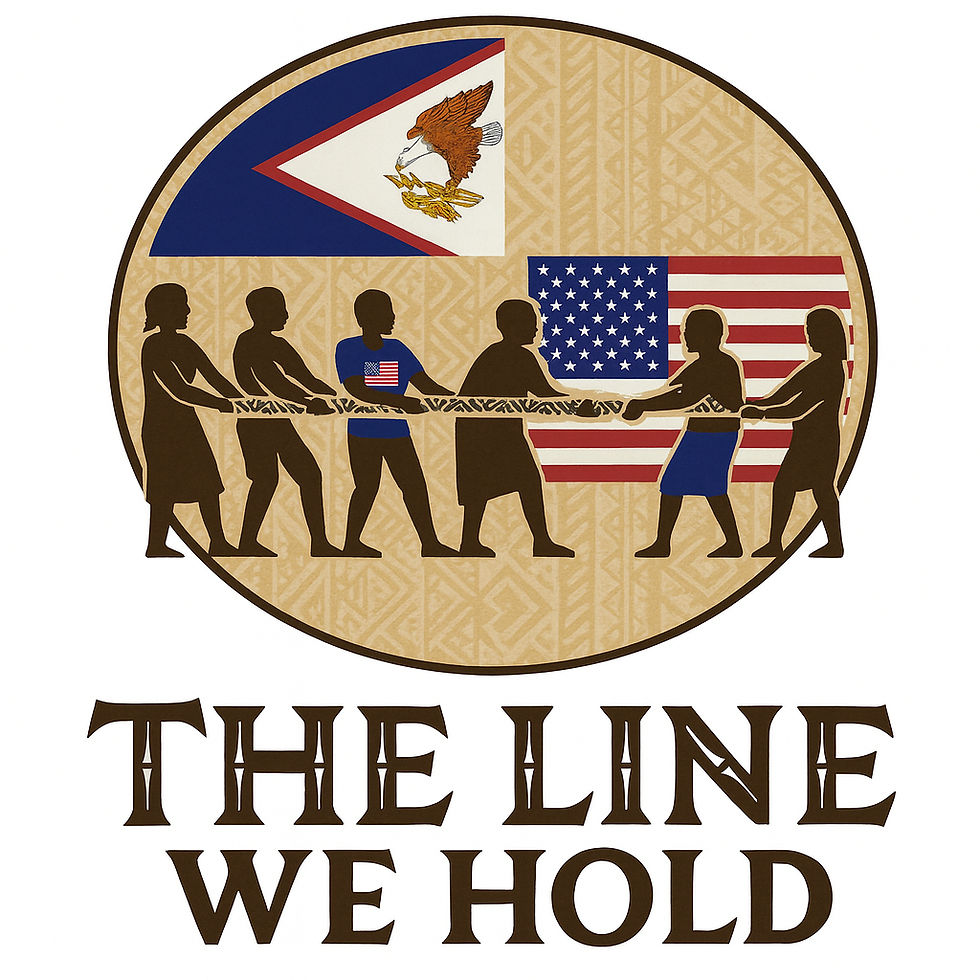
Looking back now, I realize that moment planted the seed for something I would later come to describe as The Line We Hold.
It is the space where two worlds meet. One world calls for deference and silence in the presence of authority. The other calls for participation, accountability, and civic engagement. The challenge for our community has always been learning how to honor both.
That day, the conversation in the community was not really about my comment. It was about that tension. Some believed culture required silence, while others believed citizenship required speaking.
Somewhere between those expectations is the line we hold as a people.
What stayed with me most from that day, however, was Governor Lolo’s response.
He did not condemn me. He did not dismiss my words, and he did not try to silence me. Instead, he acknowledged the comment and commended the courage it took to speak in that moment. He reminded the room that young people who return home wanting to serve their community should not be criticized for speaking. They should be encouraged.
Even in the moment itself, while I was speaking, he never interrupted me or shut me down. He listened.
To me, that is the mark of a confident leader.
Leadership is not simply about authority. It is also about the strength to hear voices that challenge you. A lesser leader might have taken offense or ended the conversation. Governor Lolo chose to listen.
As our community reflects on his life and leadership, that is the memory I carry with me. I remember a room full of authority, a young voice speaking honestly, and a leader strong enough to receive it.
For that moment, and for the example it set, I will always hold respect and appreciation for Governor Lolo Matalasi Moliga.
May he rest in peace.


I loved it! Like I always said to you, you go do you! It seems that our women folks in American Samoa have a better grip on what and where our island nation should be headed. Malo lava, and we’re all going to miss Kovana Lolo. Stay safe, Poumele