
Holding the Line When Systems Bend: American Samoa at a Crossroads


This entry took longer than expected to put together - not because the ideas were unclear but because the issues are layered and require care in how they are approached. With the aspirations I hold and the work I hope to contribute to in the future, it felt important to write this in a way that is steady, objective, and measured. After several revisions, this piece now reflects what I intended: a clear, concise discussion about the trends we are seeing and why holding the line matters.
------------
For as long as I can remember, I’ve seen the quiet but persistent tension between the Western individualistic system we operate under and the fa’aSamoa collectivistic values that shape our identity. I have always believed that if we could draw from the best of both worlds - the structure and accountability of Western governance, and the compassion, respect, and unity of Samoan culture - American Samoa could build something uniquely strong.
But recent developments within the American Samoa Government show how challenging it can be to navigate these two frameworks at once. When disagreements arise between branches, when statutory interpretation becomes uncertain, or when systems bear weight they were never designed to carry alone, the boundaries between culture and law begin to blur. These moments don’t point to bad actors or intentions; they highlight how delicate the balance truly is.
One trend we’ve seen is the recurring strain between branches of government -particularly when priorities, authority, or fiscal oversight diverge. Conflict is normal in any government, but in a society rooted in fa’aSamoa, conflict is often softened or delayed to preserve harmony. This can unintentionally create situations where clarity is needed sooner than it arrives, making the “line” between cultural respect and legal accountability harder to hold.
Another trend involves uncertainty around statutory boundaries. Even when the law is clear, political dynamics or structural pressures can complicate how it is applied. These moments don’t necessarily reflect misconduct; they simply reveal how challenging it is to uphold consistency within systems influenced by culture, hierarchy, and long-standing relationships. When legal clarity bends, even slightly, the line becomes blurred again.
Our justice system also continues to carry the impact of larger social issues - substance use, trauma, limited treatment infrastructure, and generational challenges. Cases often reflect conditions far beyond the control of any single agency or individual. When someone enters the system, their story is rarely as simple as an offense on paper. In many ways, they are responding to pressures produced by a society that is still learning how to reconcile its structures with its cultural expectations.
Finally, there remains a hesitancy - understandable but significant - around raising difficult issues or openly addressing inconsistencies. Out of respect for leadership, fear of repercussions, or a desire to avoid conflict, conversations that could offer clarity sometimes stall. This tension reinforces how important it is to maintain the delicate balance between cultural deference and governmental transparency.
All these trends reveal one thing: the line between law, culture, and governance is under strain.
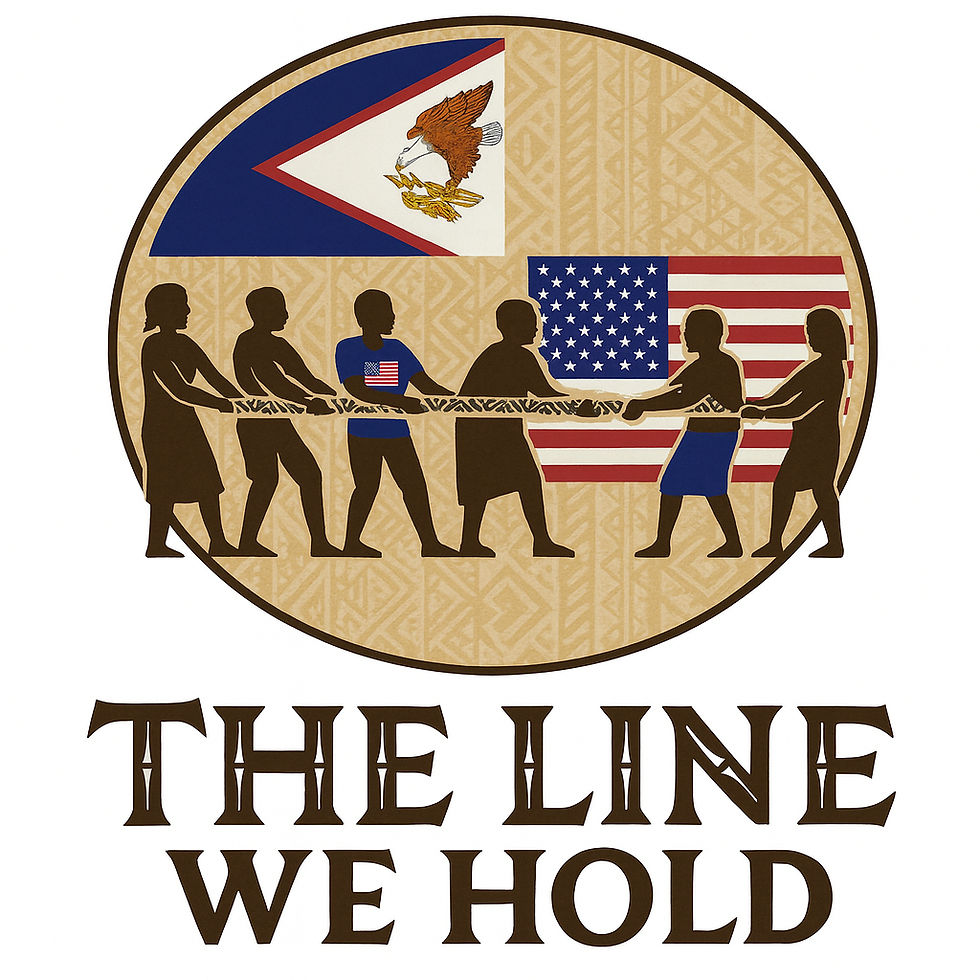
And this is why holding the line matters.
Holding the line is not about choosing Western systems over fa’aSamoa or vice versa. It is about drawing strength from both. It is about grounding ourselves in integrity, clarity, consistency, and compassion. It is about steadying the boundaries that help our institutions function while honoring the cultural values that define who we are.
A Call to Action: Restoring Balance, Reframing Justice, and Opening a New Conversation
As I reflect on these trends - the tensions, the blurred boundaries, the uncertainty? I find that they do not diminish my hope. Instead, they sharpen it. They reinforce why I believe so strongly in the potential of restorative justice here in American Samoa, and why conversations like this matter.
Restorative justice is often framed around offenders and victims, but its true scope is much broader. It is not only about responding to harm - it is about strengthening the fabric of the entire community. It recognizes that when someone enters the justice system, their actions cannot be separated from the environment that shaped them: the pressures they faced, the gaps in support, the cycles that persist when systems drift too far from their purpose.
In a society pulling against itself - where cultural expectations and legal frameworks sometimes collide - many who are labeled offenders are also, in their own way, victims of a larger imbalance. Victims of unmet needs, unresolved trauma, absent treatment, weakened structures, and the weight of systemic contradictions.
Changing how we see them does not excuse harm. It contextualizes it. It humanizes it. It allows us to respond more effectively and more honestly.
This is why restorative justice matters. It offers a way to restore what has been lost: connection, dignity, accountability, and hope. It aligns with the values of fa’aSamoa, which have always emphasized reconciliation, humility, collective responsibility, and the belief that people are not defined by their worst moments.
And this is why holding the line matters. Not just the legal line, but the moral and communal one — the line that reminds us who we are, what we value, and what we strive to restore.
A Call to Open the Conversation
If we want real progress, we need to open the conversation - gently, honestly, and without fear. We need to talk about:
how we view “offenders,”
how we understand the root of harm,
how we reconcile accountability with compassion,
and how we build systems that strengthen, rather than strain, our community identity.
This requires shifting our perspective from “What punishment is deserved?” to “What healing is necessary for all involved - the individual, the family, and the community?”
It requires seeing those in the justice system not as lost causes or burdens, but as people shaped by the same forces that challenge all of us: cultural conflict, social instability, limited resources, and systemic gaps.
Restorative justice asks us to look deeper. Holding the line asks us to stay steady. Together, they ask us to imagine a future where accountability and compassion walk side by side.
The Work Ahead
If we choose to embrace this shift - thoughtfully and intentionally - we will not weaken our systems. We will strengthen them.
We will not excuse wrongdoing. We will address its causes.
We will not divide our community. We will heal it.
This is the work ahead of us. Not to point fingers. Not to assign blame. But to restore what has been strained and to rebuild what has been lost.
To steady the line — and to do it together.


Comments